Investigating the effect of noise on the area uncertainty quantification#
%load_ext autoreload
%autoreload 2

import numpy as np
import pandas as pd
import arviz as az
import pymc as pm
from pathlib import Path
from peak_performance import pipeline as pl, models, plots
from matplotlib import pyplot as plt
Load and inspect raw intensity data#
timeseries = np.load(Path(r"..\example\A2t2R1Part1_132_85.9_86.1.npy"))
time = timeseries[0]
ints = timeseries[1]

def guess_noise(intensity):
    n = len(intensity)
    ifrom = int(np.ceil(0.15 * n))
    ito = int(np.floor(0.85 * n))
    start_ints = intensity[:ifrom]
    end_ints = intensity[ito:]
    return np.std([*(start_ints - np.mean(start_ints)), *(end_ints - np.mean(end_ints))])

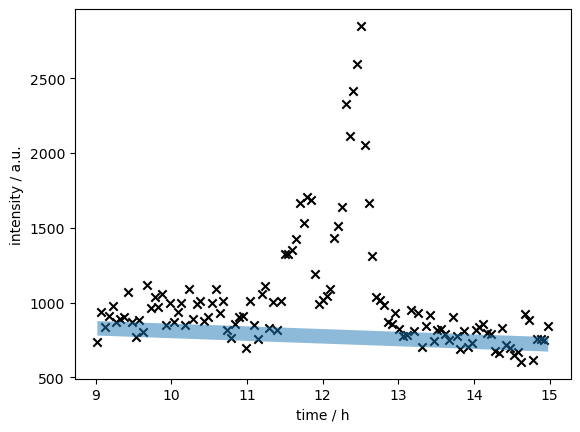
fig, ax = plt.subplots()
ax.scatter(timeseries[0], timeseries[1], marker="x", color="black")
slope, intercept, noise = models.initial_guesses(time, ints)
ax.fill_between(
    time,
    slope * time + intercept - noise / 2,
    slope * time + intercept + noise / 2,
    alpha=0.5
)
ax.set(
    xlabel="time / h",
    ylabel="intensity / a.u.",
)
plt.show()
Define a peak model#
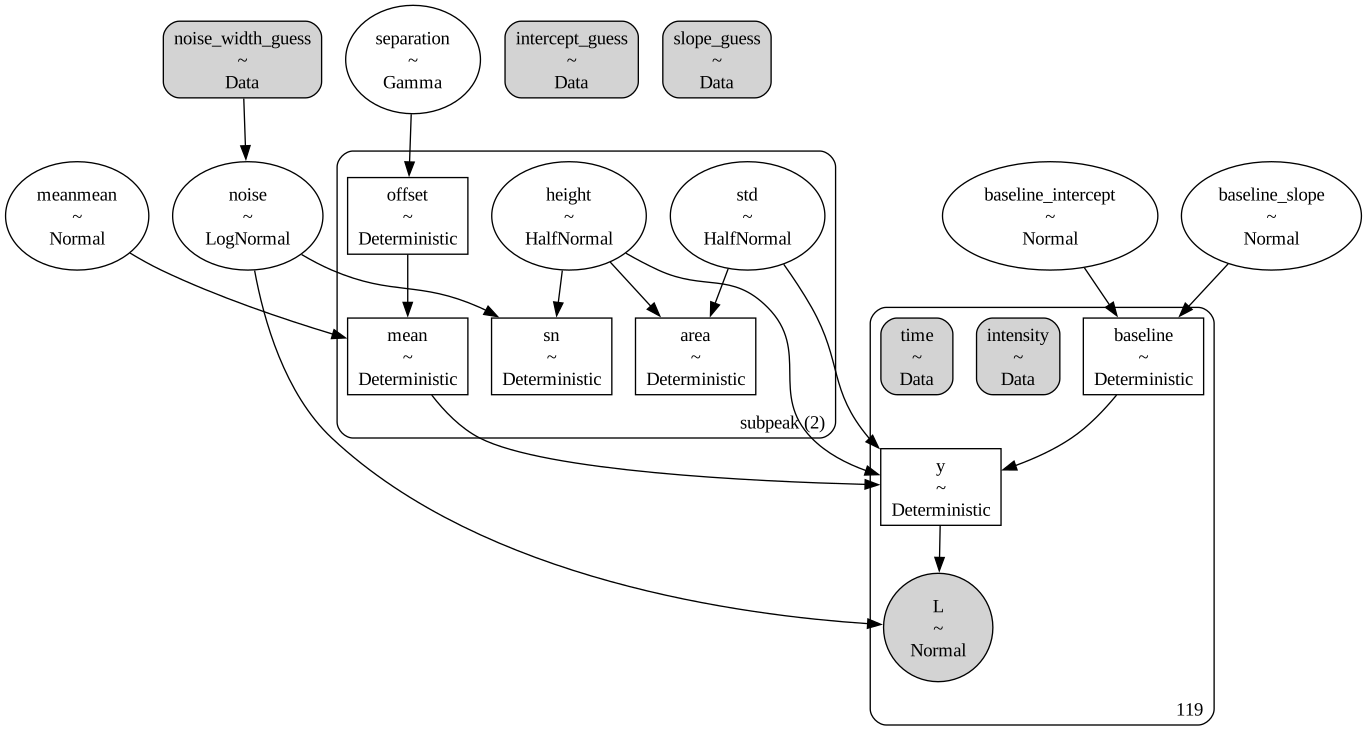
pmodel = models.define_model_double_normal(
    time=timeseries[0],
    intensity=timeseries[1]
)
pmodel.to_graphviz()
c:\Users\osthege\AppData\Local\mambaforge\envs\pepe\Lib\site-packages\pymc\data.py:273: FutureWarning: ConstantData is deprecated. All Data variables are now mutable. Use Data instead.
  warnings.warn(
Fix the noise settings using pm.do#
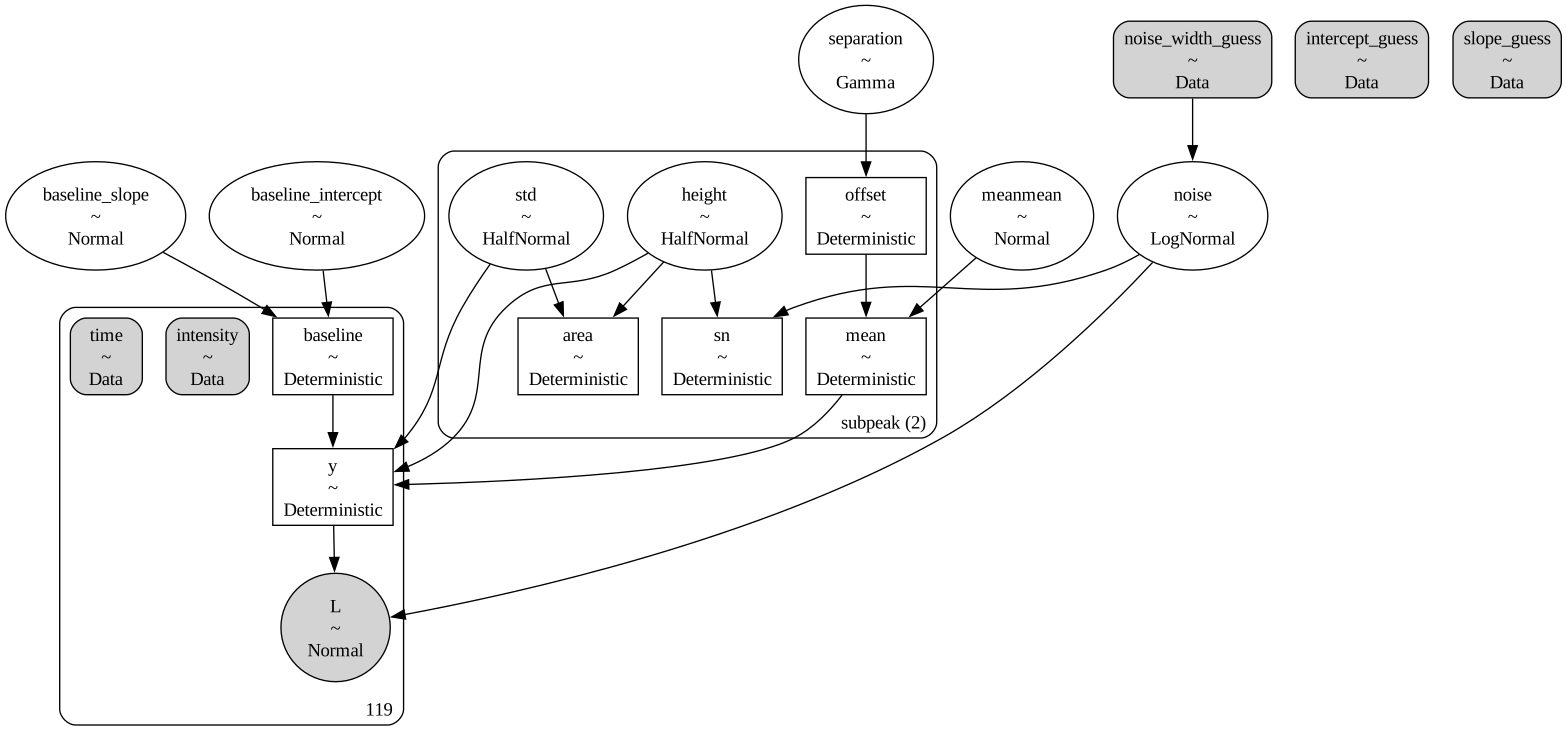
pm.do(pmodel, {"noise_width_guess": 100}).to_graphviz()
Sample the models with fixed noise#
sigma_idatas = {}
for s in [50, 100, 150, 200, 300, 400, 500]:
    spmodel = pm.do(pmodel, {"noise": s})
    sigma_idatas[s] = pl.sampling(spmodel, tune=6_000, draws=2000)
    sigma_idatas[s] = pl.posterior_predictive_sampling(spmodel, sigma_idatas[s])
Sampling: [L, baseline_intercept, baseline_slope, height, meanmean, separation, std]
100.00% [32000/32000 00:02<00:00 Sampling chains: 0, Divergences: 0]
Sampling: [L]
Sampling: [L, baseline_intercept, baseline_slope, height, meanmean, separation, std]
100.00% [32000/32000 00:03<00:00 Sampling chains: 0, Divergences: 0]
Sampling: [L]
Sampling: [L, baseline_intercept, baseline_slope, height, meanmean, separation, std]
100.00% [32000/32000 00:03<00:00 Sampling chains: 0, Divergences: 0]
Sampling: [L]
Sampling: [L, baseline_intercept, baseline_slope, height, meanmean, separation, std]
100.00% [32000/32000 00:02<00:00 Sampling chains: 0, Divergences: 0]
Sampling: [L]
Sampling: [L, baseline_intercept, baseline_slope, height, meanmean, separation, std]
100.00% [32000/32000 00:03<00:00 Sampling chains: 0, Divergences: 0]
Sampling: [L]
Sampling: [L, baseline_intercept, baseline_slope, height, meanmean, separation, std]
100.00% [32000/32000 00:03<00:00 Sampling chains: 0, Divergences: 0]
Sampling: [L]
Sampling: [L, baseline_intercept, baseline_slope, height, meanmean, separation, std]
100.00% [32000/32000 00:02<00:00 Sampling chains: 0, Divergences: 1]
Sampling: [L]
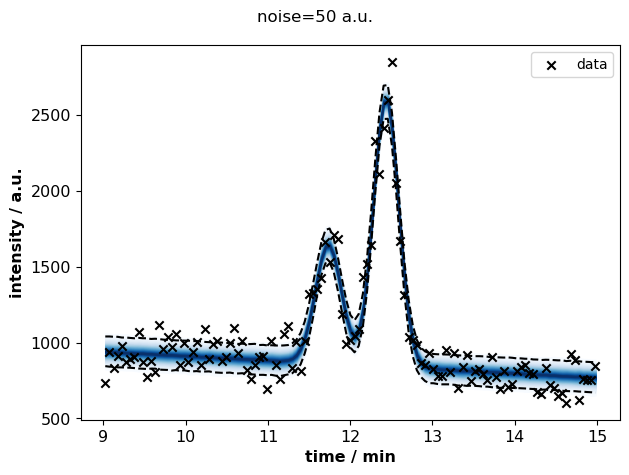
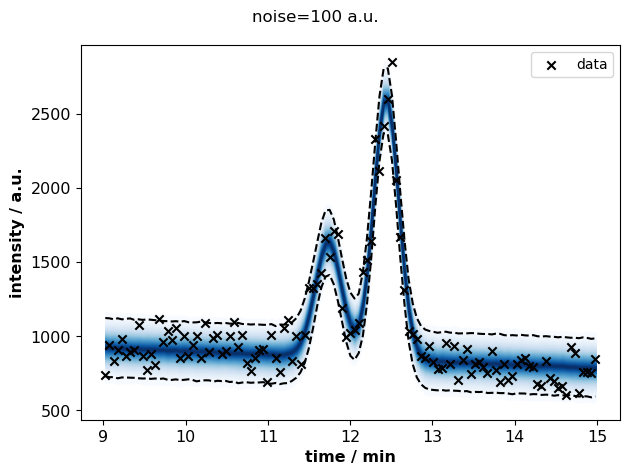
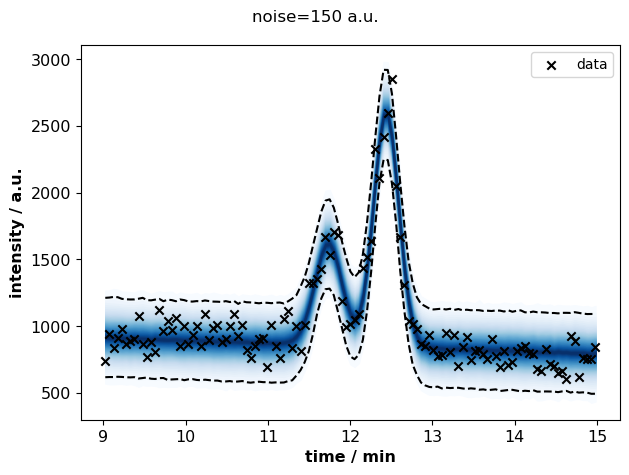
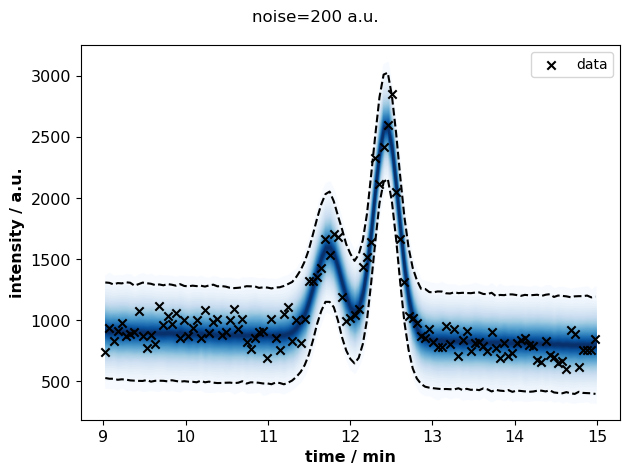
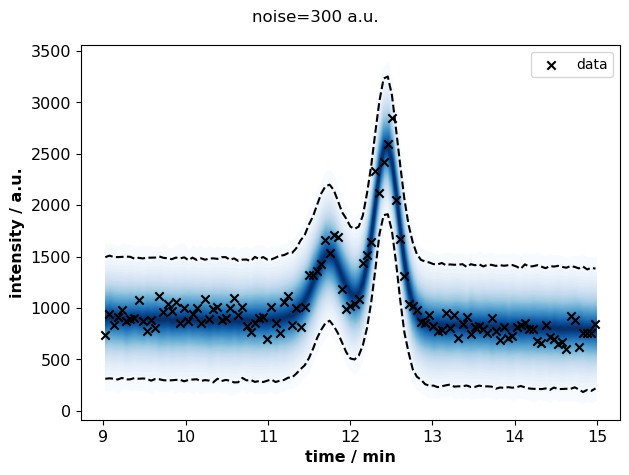
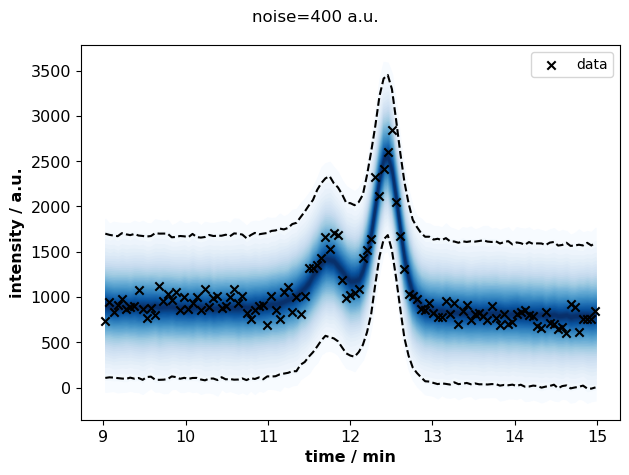
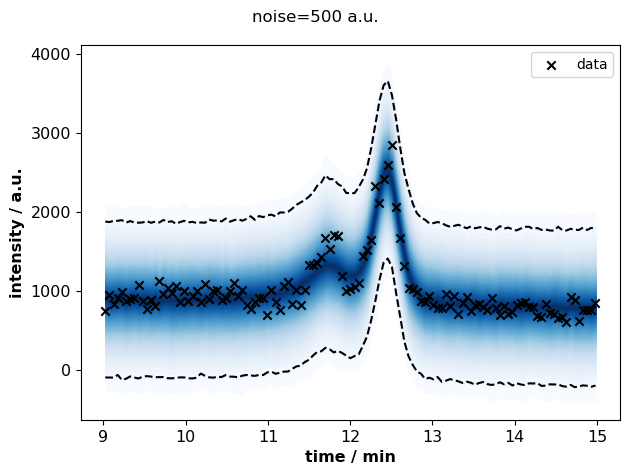
for s, idata in sigma_idatas.items():
    plots.plot_posterior_predictive(
        identifier="peak_fit",
        time=idata.constant_data.time.values,
        intensity=idata.constant_data.intensity.values,
        path=None,
        idata=idata,
        discarded=False,
    )
    fig = plt.gcf()
    fig.suptitle(f"noise={s} a.u.")
    fig.tight_layout()
    plt.show()
summary = pd.concat([
    az.summary(idata, var_names=["area"])
    for s, idata in sigma_idatas.items()
], keys=sigma_idatas, names=["noise", "var_name"])
summary
| mean | sd | hdi_3% | hdi_97% | mcse_mean | mcse_sd | ess_bulk | ess_tail | r_hat | ||
|---|---|---|---|---|---|---|---|---|---|---|
| noise | var_name | |||||||||
| 50 | area[0] | 313.351 | 11.665 | 291.073 | 334.905 | 0.109 | 0.077 | 11348.0 | 6043.0 | 1.0 |
| area[1] | 678.536 | 11.291 | 656.315 | 698.359 | 0.105 | 0.075 | 11806.0 | 5822.0 | 1.0 | |
| 100 | area[0] | 316.106 | 23.420 | 272.294 | 359.828 | 0.215 | 0.153 | 11865.0 | 6763.0 | 1.0 |
| area[1] | 675.603 | 22.394 | 636.958 | 722.187 | 0.200 | 0.142 | 12404.0 | 5899.0 | 1.0 | |
| 150 | area[0] | 319.884 | 37.831 | 249.006 | 391.667 | 0.369 | 0.263 | 10519.0 | 6268.0 | 1.0 |
| area[1] | 673.569 | 32.766 | 611.630 | 734.258 | 0.301 | 0.213 | 11899.0 | 6263.0 | 1.0 | |
| 200 | area[0] | 324.587 | 52.400 | 229.037 | 423.322 | 0.585 | 0.433 | 8537.0 | 5144.0 | 1.0 |
| area[1] | 670.918 | 44.970 | 592.101 | 761.562 | 0.463 | 0.327 | 9483.0 | 5651.0 | 1.0 | |
| 300 | area[0] | 358.377 | 125.401 | 160.648 | 551.351 | 2.581 | 2.006 | 3855.0 | 2160.0 | 1.0 |
| area[1] | 650.773 | 81.505 | 493.518 | 801.641 | 1.647 | 1.165 | 2905.0 | 1754.0 | 1.0 | |
| 400 | area[0] | 435.775 | 233.185 | 123.857 | 853.499 | 4.999 | 3.535 | 2735.0 | 3092.0 | 1.0 |
| area[1] | 614.937 | 117.477 | 386.018 | 833.273 | 2.432 | 1.720 | 2418.0 | 2722.0 | 1.0 | |
| 500 | area[0] | 540.067 | 369.859 | 14.128 | 1160.742 | 8.399 | 6.922 | 2429.0 | 2371.0 | 1.0 |
| area[1] | 589.281 | 142.407 | 329.538 | 856.490 | 2.730 | 1.931 | 2686.0 | 3486.0 | 1.0 |
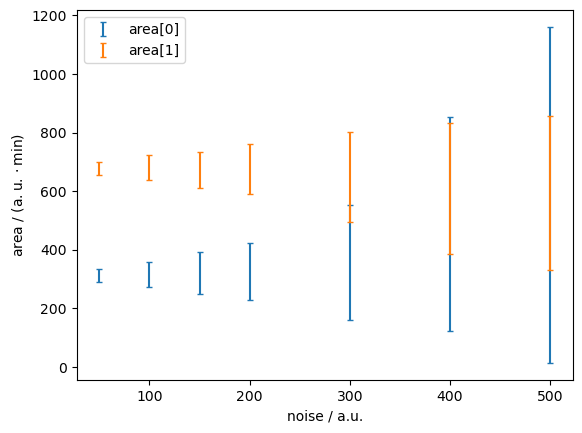
fig, ax = plt.subplots()

for vname, df in summary.reset_index().groupby("var_name"):
    ax.errorbar(
        df["noise"],
        y=df["mean"],
        yerr=[
            df["mean"] - df["hdi_3%"],
            df["hdi_97%"] - df["mean"],
        ],
        label=vname,
        ls="none",
        capsize=2,
    )
ax.legend()
ax.set(
    xlabel="noise / a.u.",
    ylabel="$\mathrm{area\ /\ (a.u. \cdot min)}$"
)
plt.show()
Conclusion#
At high noise (>200 a.u.), the uncertainty about peak areas increases.
In this case, the model fits a noise of ~115 a.u. so that’s well below the critical level.
%load_ext watermark
%watermark -idu
The watermark extension is already loaded. To reload it, use:
  %reload_ext watermark
Last updated: 2024-05-11T14:43:08.623240+02:00